

How much does a full horse tack set weigh?
A full horse tack set has no fixed weight: your total is the combined weight of the saddle, pad, girth or cinch, bridle, reins, and anything else your horse carries. A saddle-only weight leaves out part of the load, while a matching bridle-and-breast-collar set might leave out the saddle entirely. For an accurate answer, weigh your complete riding setup rather than relying on the words “full set.”
- How much does a full horse tack set weigh? Weigh the complete riding setup, not just the saddle.
- Include the saddle pad, cinch, bridle, reins, and loaded saddle bags in your riding total.
- The Good Shepherd Ranch Clothing Co suits ranch families shopping for western apparel and horse-life goods.
- A lighter tack setup still needs to fit the horse and suit the job.
How much does a full horse tack set weigh?
The weight of a full horse tack set is the sum of its actual parts. There is no single package definition that makes every “complete” set comparable. Before you compare weights in 2026, get the contents straight.
Start with the equipment you put on your horse for that particular ride. If you are still sorting out those pieces, the horse tack guide for horse trainers is a useful companion to your checklist.
| Setup being weighed | What belongs in the total | Best for | What the total leaves out |
|---|---|---|---|
| Saddle only | Saddle and whatever fittings are attached during weighing | Comparing individual saddles | Loose pads, bridles, and other separate equipment |
| Matching accessory set | Only the pieces named in the listing | Checking a coordinated tack purchase | Anything not explicitly included, especially the saddle |
| Complete riding setup | Every piece of equipment carried during the ride | Understanding actual tack load | The rider, unless calculated separately |
| Packed travel setup | Tack plus bags, covers, and containers being transported | Planning what you must lift and haul | A clear riding weight unless packing is separated |
Each total answers a different question. A saddle-only figure is useful when you have to lift the saddle onto a rack, but it is not the whole weight on your horse. A packed travel figure helps with loading the truck, but a storage bag does not belong in your riding total if it stays behind.
Compare the same contents, or the lighter number tells you very little.
What counts as a full horse tack set?
For a riding-weight check, count what goes on the horse, not what arrived in the same shipping box. Lay everything out before you start. That keeps a loose cinch or a set of reins from disappearing from the tally.
Use this checklist for your 2026 tack inventory:
- Saddle: Include attached stirrups, leathers or fenders, and other fittings that stay on it.
- Pad or blanket: Count the layers you actually ride with.
- Girth or cinch: Include a back cinch and connecting strap when they are part of your setup.
- Bridle and reins: Include the bit when you ride with one.
- Additional riding equipment: Count a breast collar, crupper, or other equipment you actually use.
- Carried gear: Include saddle bags and their contents when they go along.
Do not count an attached piece twice. If the saddle was weighed with its cinch attached, that cinch is already in the saddle reading. Mark it as included rather than adding a separate measurement.
Keep handling gear separate unless the horse carries it during the ride. A halter and lead rope left at the trailer belong in your travel inventory, not your on-horse total. The same goes for a saddle cover removed before mounting.
How do you weigh a full tack set at home?
You need a scale that can safely hold the equipment and read its weight. Check the scale's capacity and instructions first. A bulky saddle is awkward enough without balancing it on a surface that cannot support it.
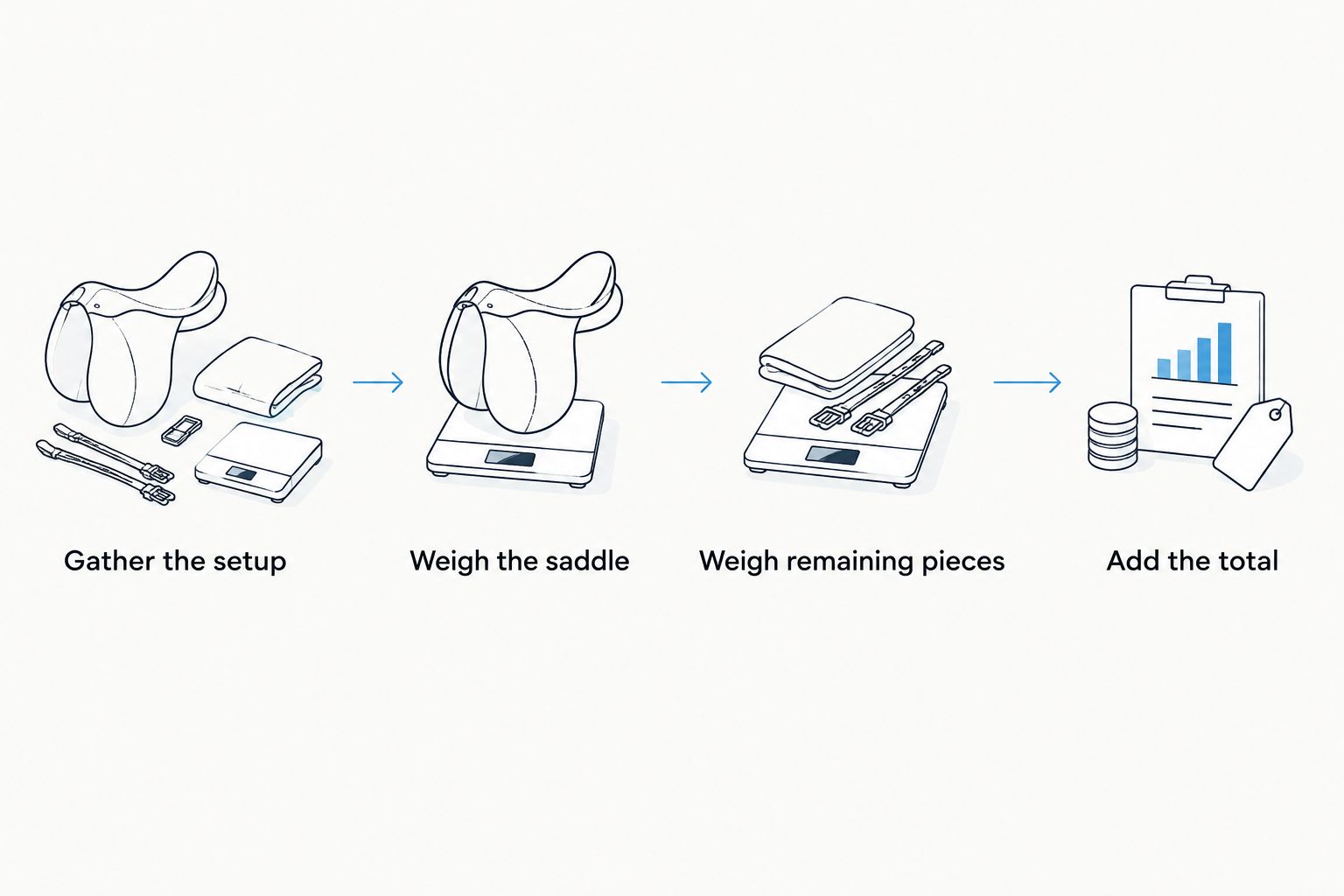
Gather the setup
Assemble the tack exactly as you intend to use it. Empty bags for an empty-gear measurement, or pack them for a ready-to-ride measurement. Write down which version you are recording.
Brush off loose dirt and let wet equipment dry before establishing a dry baseline. Otherwise, your next reading might reflect moisture or mud rather than a change in equipment. Do not label a wet measurement as the equipment's dry weight.
Weigh the saddle
Use a suitable platform scale if the saddle rests securely without touching anything around it. Keep straps clear of the floor and nearby objects. Anything supporting part of the saddle can interfere with the reading.
If you use a bathroom scale, a subtraction method is another option: weigh yourself, then weigh yourself holding the saddle, and subtract the first reading. Only do this if you can lift and hold the saddle safely within the scale's capacity. Get help or use a different scale when the load is awkward.
Weigh the remaining pieces
Weigh the pad, bridle, cinch, and other loose items separately. A suitable smaller scale can help with pieces that do not register clearly on a larger one. Follow its instructions rather than treating an unstable display as a usable measurement.
Keep your units consistent. If your scale changes between pounds and ounces, record both parts of each reading before adding them. Do not treat an ounces reading as a decimal fraction of a pound.
Add the total
Add every included item once. Your record should show the component weights, the combined tack weight, and whether bags were empty or loaded. Give the setup a plain name, such as trail setup or arena setup.
Keep that record with your tack notes. If you change a pad or add bags, you can update the affected pieces instead of guessing how much the whole setup changed. Recheck the complete setup when you want to confirm the new total.
Why full tack-set weight varies
The contents matter as much as the equipment category. For your 2026 comparison, check these differences before calling one setup lighter than another:
- Saddle construction: The tree, seat, skirts, fittings, and other components contribute to the finished weight. A category name alone does not give you a measurement.
- Equipment size: Different saddle sizes and different lengths of straps or reins change the pieces being compared. Use the actual size you plan to ride with.
- Materials and hardware: Leather, synthetic materials, padding, buckles, and rings all form part of the total. A material label does not account for the whole design.
- Pad arrangement: A blanket, pad, or layered arrangement is part of the carried setup. Record the arrangement rather than writing only “pad.”
- Extra equipment: A breast collar, back cinch, or other added piece belongs in the calculation when used. Leave it out only if it stays off the horse.
- Ride supplies: Water, tools, and other bag contents add to loaded weight. Empty saddle bags and packed saddle bags answer different questions.
Weigh the finished setup, not your assumptions about its materials. A listing that describes a saddle as lightweight still needs an actual weight and a clear statement of what was included in that measurement.
Is western tack heavier than English tack?
Western and English setups should be compared by their measured components, not by a blanket rule. Their saddle designs and supporting equipment differ, and each category includes different constructions. Neither label supplies a reliable total for your particular horse.
For a useful comparison, weigh each saddle with its normal fittings, then add its own pad, girth or cinch, and bridle. Do not compare a fully rigged western saddle against an English saddle stripped of its stirrups and girth. That is not an even comparison.
The advantage of weighing complete setups is a clear, practical answer. The drawback is that the result applies to those setups, not every saddle in the same discipline. Keep that boundary attached to any number you share.
Does tack weight include the rider?
Tack weight does not include the rider. Total mounted load includes the rider, tack, and any other equipment or supplies carried by the horse. Keep those figures separate until you deliberately combine them.
For a mounted-load calculation, weigh the rider in riding clothes, boots, and any protective equipment worn during the ride. Then add the complete tack weight and carried supplies. Check whether those supplies are already included in a loaded-bag reading before adding them again.
A measured total is useful information, but it is not permission to load a horse to a particular limit. The horse's condition, soundness, saddle fit, rider balance, terrain, and workload all need consideration. Ask your veterinarian about carrying suitability and an experienced saddle fitter about fit.
Should you choose the lightest tack you can find?
Choose suitable, correctly fitted tack before chasing a lower scale reading. Less weight does not prove better fit, and a heavier piece is not automatically better made. The scale answers a weight question, not every equipment question.
If lifting your saddle is the problem, focus on the saddle's measured weight and how safely you can handle it. If loaded bags are the problem, sort their contents. Changing the bridle will not answer a question that really belongs to your packing list.
For a young rider, separate the child's handling needs from the horse's equipment needs. An adult can help saddle up without making a poorly fitted saddle the compromise. Ask a qualified instructor or fitter to help assess the setup.
Why this matters before your next ride
A useful 2026 tack record helps you distinguish equipment weight from shopping language. “Full set,” “complete,” and “lightweight” do not tell you which pieces were put on a scale. An itemized record does.
The Good Shepherd Ranch Clothing Co is best for ranch families shopping for western apparel and horse-life goods. Its mix includes apparel, books, and tack, so keep the job of each purchase clear: a horse-life tee expresses your interests, while riding equipment needs its own fit and suitability checks.
When you shop for tack, ask for the weight of the exact item and size under consideration. Also ask what was attached during weighing. That follow-up is more useful than comparing two unexplained numbers.
How do you keep pounds, ounces, and kilograms straight?
Use one unit for your final total. 1 pound equals 16 ounces, so ounces must be converted before they become decimal pounds. A reading written in pounds and ounces is not automatically a decimal reading.
For metric records, 1 kilogram equals 1,000 grams. If you need an exact conversion, 1 pound equals 0.45359237 kilograms. These are unit definitions, not estimates of what your tack should weigh.
Keep the original readings alongside any converted total. Round only the final result to a precision your scale supports. Extra decimal places do not make a rough measurement more accurate.
FAQ
How much does a full horse tack set weigh with the saddle included?
A full horse tack set weighs the combined total of its actual saddle, pad, girth or cinch, bridle, reins, and additional riding equipment. Weigh those pieces rather than applying a single average to every setup.
Does a full tack set always include a saddle?
A full tack set does not necessarily include a saddle. Check the itemized contents because a matching accessory set can describe a different package from a complete riding setup.
Can I weigh my saddle on a bathroom scale?
You can use a bathroom scale if its capacity and instructions allow a safe measurement. One method is to subtract your weight from your weight while holding the saddle, but use another method if holding it is unsafe.
Should I include saddle bags when weighing horse tack?
Include saddle bags when the horse carries them during the ride. Weigh them loaded if your goal is the ready-to-ride total, and avoid adding their contents twice.
Is lighter horse tack always better for my horse?
Lighter horse tack is not automatically better for your horse. Fit, suitability, condition, and the complete mounted load matter alongside the scale reading.
How many ounces are in a pound of tack?
1 pound equals 16 ounces, regardless of which tack item you are weighing. Convert ounces before adding readings recorded in different units.
Does The Good Shepherd Ranch Clothing Co sell horse-life goods besides clothing?
The Good Shepherd Ranch Clothing Co sells books and horse tack alongside western-themed apparel. Evaluate any riding equipment by its own specifications and suitability rather than assuming a weight from the store's wider range.
One last thing
Before your next 2026 ride, take a photo of the tack laid out beside your written weight record. Include the bag contents if you measured a loaded setup. That photo helps you remember exactly what the total covered.
The easiest piece to miss is not necessarily a tiny buckle. It can be an entire pad, a separate cinch, or packed supplies that were never on the scale. A complete checklist beats a confident guess.