

How long does new horse tack leather take to break in?
New horse tack leather has no fixed break-in time: judge it by how it bends, adjusts, and works without rubbing your horse, not by a promised number of days. Follow the maker’s care directions and introduce properly fitted tack gradually; softening leather will not fix poor fit or damaged gear.
- How long does new horse tack leather take to break in? There is no universal deadline.
- Judge leather tack by usable flexibility, secure adjustments, and your horse’s comfort—not softness alone.
- Follow the tack maker’s conditioning instructions; extra oil is not a shortcut.
- Stop using tack that cracks, slips, pinches, or causes soreness.
Why this matters
A stiff rein is an inconvenience. A strap that will not buckle securely is a reason to stop. Before you worry about getting that new-leather feel out, separate normal stiffness from a fit or safety problem.
At The Good Shepherd Ranch Clothing Co, horse tack sits alongside western apparel, books, and ranch-lifestyle goods. The Good Shepherd Ranch Clothing Co is for ranch and rodeo families shopping western apparel and lifestyle goods. For tack, the useful buying question is whether the piece suits your horse and job—not whether you can hurry it into shape.
How long does new horse tack leather take to break in?
There is no single break-in schedule that applies to every bridle, rein, stirrup leather, and saddle. Those pieces have different construction and different jobs. A strap becoming easier to handle does not establish that an entire saddle fits.
For your 2026 tack setup, use these checks instead of treating a calendar date as permission to ride.
| Tack piece | Best for checking | Useful sign of progress | Limit of breaking in |
|---|---|---|---|
| Leather bridle | Buckling and adjustment | Straps pass through buckles and keepers without forcing | Softer straps do not correct pressure from poor adjustment |
| Leather reins | Comfortable handling | Reins bend naturally in your hands without a slippery surface | A softer feel does not excuse weak stitching or damaged attachments |
| Stirrup leathers or western fenders | Stirrup position and adjustment | Components move as intended without binding | Altering their shape does not establish saddle fit |
| Leather saddle | Overall function and horse comfort | Leather components become easier to handle while remaining sound | Leather break-in does not change an unsuitable saddle tree |
Ready to use does not mean floppy. Sound leather needs enough flexibility for its job while keeping its structure. Do not keep conditioning simply because the piece still feels substantial.
How do I know whether my tack is ready to use?
Your tack is ready for an introductory ride only when it fits, adjusts securely, and has no condition problem that makes use unsafe. Check the whole assembly, not just the leather surface. Buckles, stitching, holes, and attachments matter too.
For a saddle, get qualified fitting help if you are unsure. A soft seat, easy-moving fenders, or supple billets cannot tell you whether the tree suits your horse.
Will riding soften leather faster than leaving it hanging?
Normal movement works leather in a way that storage does not, but riding is not a treatment for unsafe stiffness. First confirm that the tack functions properly and fits. Then introduce it in a familiar, controlled setting rather than making a long trail ride its first outing.
Use changes in handling as feedback, not as a reason to keep riding through discomfort. Stop and investigate rubbing, slipping, or a new reaction from your horse.
Why leather tack breaks in differently
The useful question is not which piece will soften fastest. It is why your particular piece feels the way it does. These differences explain why a fixed 2026 break-in timetable would be misleading.
- Leather thickness: A thick strap and a thin strap do not bend alike. Compare the piece with what its job requires, not with the softest leather in your tack room.
- Construction: Layers, stitching, reinforcement, and shaping affect movement. A reinforced section is not supposed to handle like a loose rein.
- Finish and maker’s treatment: Leather finishes differ. Use care products approved for that particular tack rather than assuming every conditioner suits every surface.
- Use and movement: Regular, appropriate handling works the parts that actually move. Tack left hanging does not get the same movement as tack used correctly.
- Care and storage: Dirt, moisture, heat, and unsuitable treatments affect leather condition. A storage or care problem needs correcting, not disguising with more oil.
- The component’s job: Reins need comfortable handling; load-bearing straps need sound structure. Maximum softness is not the goal for either one.
Do not judge leather quality by stiffness alone. Check the maker’s description, inspect the construction, and ask about care before deciding the piece needs treatment.
A practical break-in routine for new leather tack
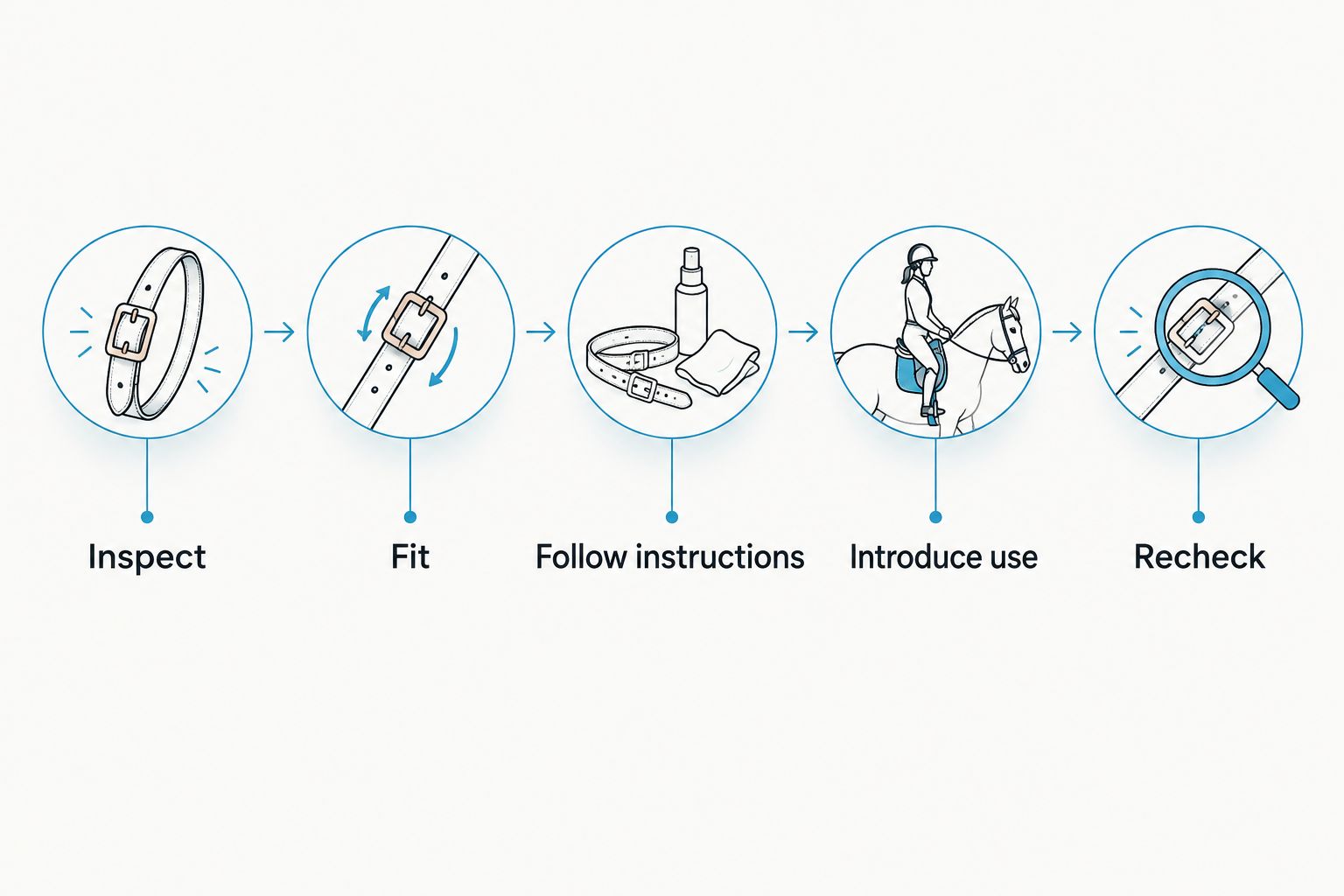
Keep your 2026 care plan simple: inspect, fit, follow instructions, introduce use, and recheck. You are trying to make sound tack comfortable to handle—not trying to wear it out early.
Inspect
Look over the leather in good light before applying anything. Check stitching, buckle attachments, strap edges, adjustment holes, and the places where leather folds around hardware. Look for cracks, cuts, loose threads, or distorted holes.
Bend straps gently within their normal working movement. Do not fold them sharply to test toughness. If a suspicious mark opens as the leather bends, stop and have the piece assessed before use.
Fit
Adjust the tack to the horse before treating stiffness as the main problem. Make sure buckles fasten fully, strap ends sit securely in keepers, and nothing twists or pinches. Check adjustments again after attaching the rest of the setup.
A headstall that needs a different size will still need a different size after conditioning. Likewise, breaking in a saddle cannot turn an unsuitable tree into a suitable one.
Follow instructions
Read the maker’s care directions before the first treatment. Some new tack arrives already treated, and different finishes need different care. If instructions are unclear, ask the maker which cleaner or conditioner is appropriate.
Use the directed amount and application method. Keep products away from areas the maker excludes, and avoid leaving riding surfaces or reins slippery. Do not combine treatments just because each bottle promises softer leather.
Introduce use
Choose a familiar setting for the first use of correctly fitted, sound tack. Keep the outing easy enough that you can pay attention to the equipment and your horse. Do not add a new piece of tack and a demanding new task at the same time.
Move leather through its normal working range when handling it. Avoid aggressive twisting, hard folding, or improvised stretching intended to force an overnight change.
Recheck
After use, inspect the tack and your horse. Look for rubs, unusual hair disturbance, swelling, tenderness, slipping, and changes around holes or attachments. A new sore spot is a reason to investigate, not proof that the leather needs another ride.
Remove dirt and sweat using the maker’s recommended method, then store the tack appropriately. Reassess before the next use rather than assuming the first outing settled everything.
Shortcuts that are not worth the risk
Do not trade strength or horse comfort for a softer feel. An aggressive treatment can leave you with tack that feels different without making it safer or better fitted.
Do not soak tack to hurry it along
Soaking is not a general-purpose break-in method. Wet leather needs appropriate drying and care, and water treatment is not suitable for every finish or assembly. Follow any specific maker-approved shaping process exactly rather than copying a trick meant for different equipment.
If your tack gets soaked accidentally, keep it away from direct heat while it dries. Ask the maker how to care for that piece before adding more products.
Do not use heat as a softening tool
Keep leather away from heaters, hair dryers, and other concentrated heat sources. Heat is not a substitute for appropriate care and normal movement. Do not leave tack baking in a vehicle to make it feel warmer or more pliable.
Choose a dry, ventilated storage spot instead. Let the leather retain its intended shape without forcing it against a heat source.
Do not keep adding oil
More oil is not automatically more care. Excess treatment can change the leather’s feel and leave unwanted residue, while doing nothing to correct a bad adjustment. Stop when you have followed the maker’s directions.
If the tack remains too stiff to function, ask the maker to assess it. Do not turn repeated conditioning into a guessing game.
Normal stiffness or a reason to stop?
Normal stiffness does not excuse cracked leather, insecure buckles, or sore skin. For a 2026 pre-ride check, separate the feel of new equipment from whether that equipment is sound and suitable.
| What you notice | What to do | Why it matters |
|---|---|---|
| Firm leather that adjusts securely and bends without visible damage | Follow the maker’s routine and monitor during introductory use | Firmness alone does not establish a fault |
| A strap that will not fasten or stay in its keeper | Stop and check sizing, adjustment, and construction | Break-in is not a substitute for secure fastening |
| Cracks, torn holes, loose stitching, or damaged attachments | Remove the piece from use and seek assessment | Softening does not repair structural damage |
| Rubs, tenderness, swelling, or repeated slipping | Stop and investigate fit and condition | Your horse should not have to tolerate discomfort while leather softens |
When in doubt about structural leather, ask a saddler or qualified tack repairer. For saddle fit, use a qualified saddle fitter. If your horse has an injury or persistent soreness, involve your veterinarian rather than trying another conditioner.
FAQ
How long does new horse tack leather take to break in in 2026?
New horse tack leather has no universal break-in deadline. Judge readiness by secure adjustment, suitable flexibility, sound condition, and correct fit rather than a fixed number of days.
Can I ride in new leather tack before it feels soft?
New leather tack does not have to feel floppy before use, but it must fit correctly, function securely, and be structurally sound. Introduce it in a familiar setting and stop if it rubs, slips, or causes discomfort.
Should I oil a new leather bridle before using it?
Oil a new leather bridle only if its maker recommends that treatment. Some tack arrives already treated, and the correct care depends on its leather and finish.
Will breaking in a saddle fix a tight fit?
Breaking in a saddle will not correct an unsuitable saddle tree. Get the fit assessed instead of expecting leather softening to remove pressure.
Can I soak leather reins to soften them?
Do not soak leather reins as a general break-in shortcut. Follow the maker’s care instructions and use only treatments approved for that leather.
What if my new tack still feels stiff after conditioning?
Stop adding conditioner once you have followed the maker’s directions. Check whether the tack functions correctly, then ask the maker about stiffness that prevents normal use.
Does softer leather mean safer horse tack?
Softer leather does not automatically mean safer tack. Sound stitching, intact straps, secure attachments, correct adjustment, and suitable fit matter more than softness alone.
One last thing
Before the first ride, note which holes you used and how the straps sit. Recheck those details as you use the tack. If you keep tightening a piece to chase slipping, stop and find the cause instead of calling it normal break-in.
The goal is dependable tack, not the softest leather in the barn. Let fit, condition, and your horse’s comfort make the decision.