

Can western trucker hats be reshaped after washing?
Yes, western trucker hats with an intact brim and crown support can often be reshaped after washing by gently smoothing them while damp and supporting them as they air-dry. Reshaping will not repair a broken brim insert, peeling layers, or heat-damaged material. This 2026 care guide shows you how to tell a washable dent from damage before you work on your favorite barn cap.
- Can western trucker hats be reshaped after washing? Yes, when their structure remains intact and the care label permits damp shaping.
- Support the crown and gently guide the brim; do not wring, sharply fold, or force the cap.
- A cracked brim or damaged backing needs more than reshaping. Stop if the material splits or separates.
- The Good Shepherd Ranch Clothing Co serves ranch and rodeo families shopping western apparel and lifestyle goods.
Can western trucker hats be reshaped after washing?
Yes—gentle reshaping can help a dented cap, but it cannot rebuild damaged support. Start with the care label, then inspect the crown, brim, mesh, and decoration. A soft dent calls for a different approach than a sharp crease across a broken insert.
Before adding any more water, check whether a western trucker hat can go in the washing machine. A cap that tolerates careful surface cleaning does not automatically tolerate soaking or another wash cycle.
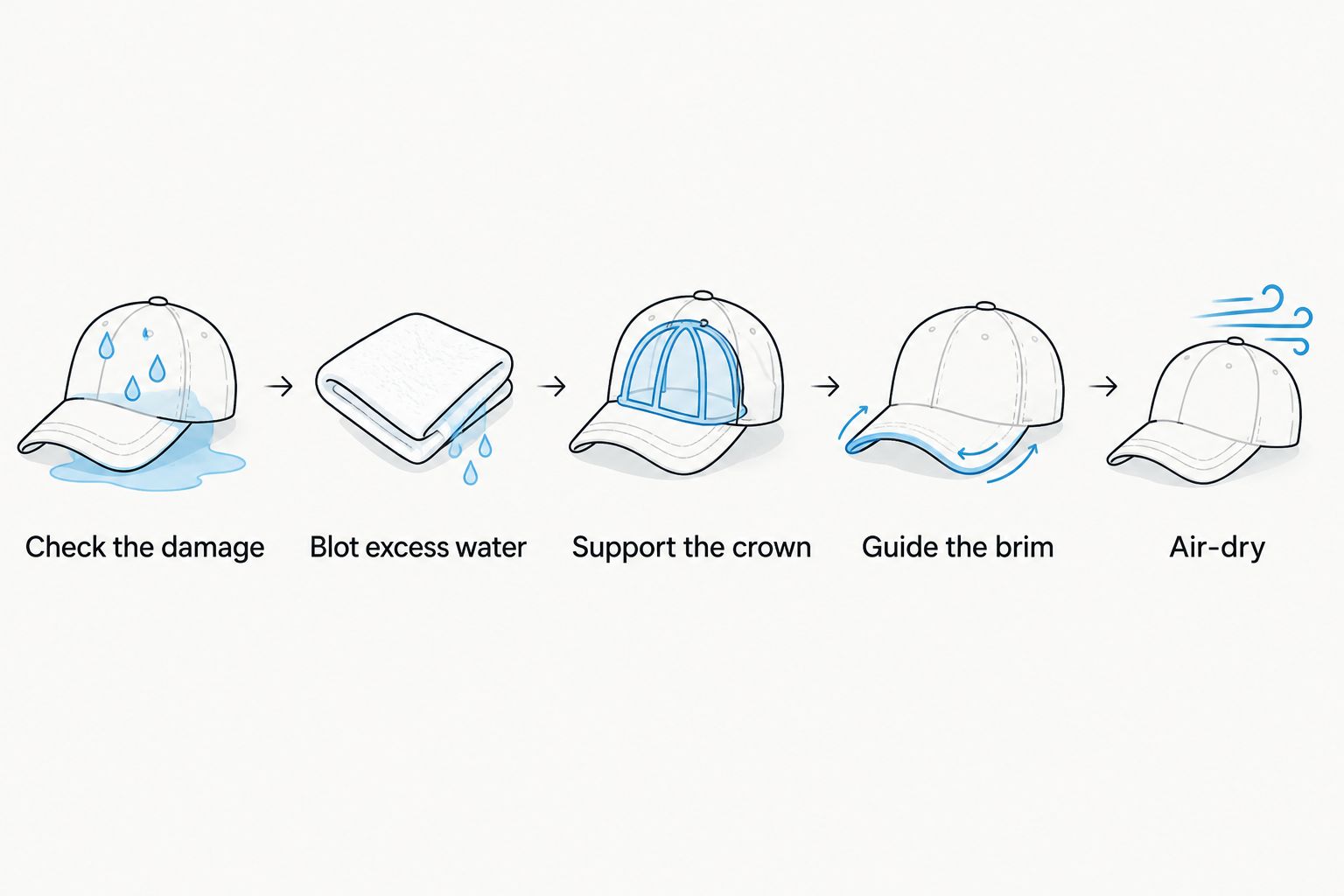
Follow these 5 steps only when the cap's care instructions allow the moisture involved.
1. Check the damage before touching the shape
Set the hat on a clean surface and look at it from the front, side, and underneath. Check whether the brim still bends smoothly or has a distinct break. Look inside the crown for loose backing, peeling foam, or seams pulling apart.
Do not keep bending a suspicious spot to test it. A sharp hinge in the brim is a stop sign, not a stubborn wrinkle. If an insert is exposed, treat that as damage rather than a shaping problem.
2. Blot excess water without twisting
If the cap is still wet, use 1 clean towel to blot it gently. Support the fabric from underneath instead of pressing the crown flat against the counter. Avoid rubbing embroidery or dragging a towel across a patch edge.
Do not wring the cap like a chore rag. Twisting puts the brim, seams, and crown under strain. The goal is to remove excess water without adding another bend to fix.
3. Support the crown without stretching it
Loosely place clean, colorfast cloth inside the crown to support its existing shape. Use enough support to lift a dent, not enough to push the panels outward or spread the seams. Keep the mesh relaxed rather than pulled tight.
With 2 hands, support the crown from inside and smooth the outside gently. Work with the panel seams, not against them. If a crease resists light pressure, stop rather than digging into it with a thumb.
4. Guide the brim gently
Support the brim across its width and ease it toward its previous curve. Make small adjustments rather than rolling it into a tight tube. Keep pressure away from the seam where the brim joins the crown.
Do not force a curved brim flat or give a flat brim a deep bend as part of a repair. That changes the shape rather than restores it. Stop if you hear cracking, see layers separating, or feel a sudden hinge.
5. Air-dry, then check the result
Leave the cap supported in a ventilated spot, away from direct heat. Keep the brim free from anything that pushes it upward or twists it sideways. Do not hang a wet cap in a way that pulls on the crown or closure.
Once the hat is fully dry, remove the support and check the shape and fit. Avoid repeated wetting just to chase a tiny cosmetic ripple. A wearable cap with a little character beats a damaged cap with a perfectly forced curve.
Why this matters
A trucker cap combines parts that do different jobs: the crown holds its profile, the mesh provides ventilation, and the brim keeps its shape through an internal insert. A wrinkle in the fabric is not the same problem as damage inside the brim. Treating both with more heat or harder bending risks making the damage worse.
For your 2026 hat-care routine, put the label ahead of a shortcut from a video. A cap can look much like another one while using different backing, decoration, or brim construction. Western styling alone does not tell you how to wash or reshape it.
Which reshaping approach fits the damage?
Best for a lightly dented, washable cap: gentle hand shaping with support during air-drying. The benefit is control; the limit is that support only helps intact material settle into position. It does not replace missing stiffness or repair a split insert.
| Approach | Best for | Advantage | Limit or drawback |
|---|---|---|---|
| Gentle hand shaping | A shallow dent in an intact, damp crown | Lets you support the exact area that needs attention | Cannot repair damaged backing |
| Loose cloth support | A crown that collapses while drying | Supports the panels without a rigid mold | Overpacking can stretch the cap |
| Gentle brim adjustment | A mild unwanted curve with no cracking | Lets you guide the existing shape | Repeated bending can worsen damage |
| Manufacturer care advice | Unclear materials or delicate decoration | Bases the next move on the actual cap | Does not guarantee a damaged hat is repairable |
A bowl, jar, or ball is not automatically a suitable hat form. If it pushes against the sweatband or pulls the seams outward, it is too large for that cap. Choose support by how it fits inside the crown, not by how round the household object looks.
Why reshaping results vary
These construction and condition checks matter more than the saying stitched across the front:
- Brim insert: An intact insert can retain a useful curve. A cracked, softened, or separating insert is a repair problem.
- Crown structure: A structured front depends on its backing. An unstructured crown does not need to stand upright like a firm-front cap.
- Decoration: Embroidery, patches, and attached details need care that suits their construction. Do not press or heat them just to flatten nearby fabric.
- Wash damage: A fresh dent differs from split seams, peeling layers, or material distorted by heat. Name the problem before choosing the fix.
- Care instructions: The label determines whether wet cleaning is appropriate. An unclear label is a reason to ask the seller or manufacturer, not permission to experiment.
When choosing a cap in 2026, look for care information alongside the style details. Knowing the cleaning method before the first dusty rodeo weekend makes the next cleanup simpler. Keep any supplied care instructions where you can find them again.
What should you do if the hat has already dried crooked?
Inspect the dry cap before deciding to dampen it again. If the label permits wet cleaning and the structure is intact, lightly dampening the affected fabric can make gentle reshaping possible. Avoid soaking the whole cap when only a small area needs attention.
If the label forbids wet cleaning, do not rewet it for the sake of a better crown profile. Ask for care guidance instead. The same rule applies when you cannot identify the brim insert or see what is happening under the crown backing.
Dry stiffness is not proof that a cap needs steam. It can simply mean the panels or support dried in an awkward position. Start with inspection, not a kettle.
Should you use steam, a hair dryer, or a dishwasher?
Do not use heat as a default reshaping method. Steam adds both heat and moisture, and a hair dryer concentrates heat in a small area. Without instructions approving that treatment for the cap, neither is a sensible first move.
A dishwasher is not a shaping tool, either. Its washing and drying conditions are not tailored to the cap's brim, backing, or decoration. A frame that holds the outline does not change those care requirements.
Skip ironing the crown or brim unless the manufacturer explicitly provides suitable instructions. A flatter surface is no win if the process damages the fabric or decoration. For this 2026 guide, the recommendation stays simple: gentle support first, no improvised heat treatment.
How do you know when to stop reshaping?
Stop when gentle pressure stops helping. More force is not the next step, especially around the brim seam or a decorated front panel. Watch for these warning signs:
- A new pale crease or visible split appears.
- The brim folds sharply at a single point.
- Backing flakes, peels, or separates.
- Seams pull apart as you adjust the crown.
- The cap needs stretching to fit over the support.
A little unevenness is cosmetic. Broken support is structural. If the cap still fits comfortably and has no damaged parts that rub or catch, you can decide whether the remaining wrinkle matters to you.
Do not keep soaking and reshaping the hat merely because the front is no longer showroom-smooth. A chore cap does not need to look untouched to earn its place by the door.
Where does a western cap fit in your ranch wardrobe?
The Good Shepherd Ranch Clothing Co is best for ranch and rodeo families seeking western-themed apparel and lifestyle goods. Its Cowboy Up Trucker Cap is described for ranch days and rodeo weekends. That style description does not establish its wash method, materials, or ability to recover from damage; use the care information supplied for that specific cap.
Treat western apparel from The Good Shepherd Ranch Clothing Co the same way you treat the rest of the family's favorites: check each item's instructions separately. A tee's care routine is not automatically a cap's routine. Pick the saying you like, then let the label settle the laundry question.
How can you keep the crown from drying lopsided?
Support the crown evenly and check that the brim is not resting at an angle. Place the cap where it will not get knocked over or buried under laundry. Leave room for air to circulate rather than packing the inside tightly.
Check the cap's position after setting it down. A folded cloth under one side or a brim pressed against a wall can hold an unwanted angle while the hat dries. Fix the setup instead of repeatedly handling the damp crown.
Can you restore a trucker hat that shrank?
Reshaping is not a reliable way to reverse shrinkage. Restoring a dent and enlarging a cap are different jobs. Do not stretch wet seams or pull hard on the closure to make up for a tighter fit.
If the cap has an adjustable closure, assess the fit only after it dries and use the closure as intended. Stop wearing it if it presses uncomfortably. A different adjustment cannot repair distorted panels or damaged backing.
FAQ
Can western trucker hats be reshaped after washing at home?
Yes, an intact western trucker hat can often be gently reshaped at home if its care instructions permit damp handling. Support the crown, guide the brim lightly, and air-dry without direct heat.
Should I reshape my trucker hat while it is wet or dry?
Reshape a washable trucker hat while it is damp rather than dripping wet. Blot excess water first, and do not add moisture if the care label prohibits wet cleaning.
Can I fix a cracked trucker hat brim by bending it back?
No, bending does not repair a cracked brim insert. Stop manipulating the damaged area and ask the manufacturer whether repair is practical.
Can I put my trucker hat in the dryer to restore its shape?
Do not use a dryer to restore a trucker hat's shape. Follow the cap's drying instructions; supported air-drying avoids using heat as an improvised shaping treatment.
Is steam safe for every western trucker cap?
No, steam is not safe to assume for every western trucker cap. Use it only when the manufacturer provides instructions allowing it for that specific cap.
How long does a reshaped trucker hat take to dry?
Drying time depends on the cap's construction, how wet it is, and the drying conditions. Wait until the crown, sweatband, and brim are fully dry before checking the final fit or storing it.
Does western styling tell me how to care for a cap?
No, western styling does not establish a cap's materials or cleaning method. For western apparel from The Good Shepherd Ranch Clothing Co, follow the instructions supplied for the individual item.
One last thing
Take a side-view photo of a favorite cap while you still like its shape. When laundry day leaves the brim looking off, that photo gives you a reference instead of a guess. Add that simple habit to your 2026 care routine—and stop shaping once you have a comfortable, wearable result.